February 18, 2026
5 min

Tempering Expectations on Amazon Ads' MCP Server
The launch of the Amazon Ads MCP Server deserves context. This product alone doesn't signal that Amazon is "opening its ad stack to AI agents" (as AdWeek suggests). Nor is it how AI agents like Gigi currently interact with Amazon's ad tech stack. It is, however, an intriguing glimpse into a potential future state for agent-to-platform interaction.
Amazon's API-First Advantage
Amazon Ads famously builds products "API-first," prioritizing API development before UI features. This enables partners (tech providers and agencies) to leverage new functionality immediately for advertiser benefit. Since AI agents require APIs as tools, Amazon's decade-long API-first approach has inadvertently optimized their stack for agentic AI before the category even existed. In fact, this was actually a determining factor in our decision to build Gigi for the Amazon DSP as our initial product.
Understanding Tool Calling in Agentic AI
An AI agent's power directly correlates with its available tools. Tool calling - as a concept - is fundamental to agentic AI: just as a handyman needs a hammer to hang a painting, an AI agent needs domain-specific tools to execute functions. You can't prompt ChatGPT to build an Amazon DSP campaign because ChatGPT lacks access to Amazon DSP's campaign management APIs. Gigi can build DSP campaigns because it leverages those API endpoints as tools. More tools equal greater agent capability.
The Complexity of Tool Calling Orchestration
Tool calling orchestration may seem straightforward, but executing it well requires tremendous sophistication. How efficiently an agent calls tools directly impacts perceived effectiveness. Critical concepts like reliability, latency, compute cost optimization, context window management, and security (access control and side effect management) all stem from tool calling orchestration. For many AI agents, this orchestration represents core intellectual property.
In the past two months alone, our engineering team has built breakthroughs in how Gigi leverages tools:
Programmatic Tool Calling: The LLM generates executable code that can invoke tools as functions within that program. This approach delivers two key benefits: (1) it keeps tool result data out of the context window, preserving tokens for reasoning, and (2) it eliminates multiple LLM roundtrips by executing sequential tool calls programmatically rather than requiring LLM intervention (i.e. recursive reasoning) after each call.
Self-Learning Tool Calling: Gigi analyzes repeated tool calling sequences to identify patterns and creates optimized tool call paths. When the same workflow occurs frequently, Gigi can consolidate multiple sequential tool calls into a single optimized execution path without human intervention. This reduces execution time and compute costs by up to 90%.
Tool calling orchestration is central to Gigi's value proposition. The sophistication we've built enables magical experiences to the delight of our customers. None of this would be possible if Amazon Ads hadn't ensured that AI agents could leverage every API endpoint with the same parity humans have when using the DSP UI.
Where MCP Server Fits
In theory, the MCP server could replace an AI agent's need to directly integrate with API endpoints. Here's what this means in practice:
Amazon Ads' press release for its MCP Server outlines this example: "an advertiser is running campaigns in the U.S. and Canada, we have a tool that enables them to quickly expand it to another country with a single prompt." Amazon Ads has created its own agent trained on specific tool calling workflows. An AI agent like Gigi could send the prompt "I want to clone my US campaign to Spain," and Amazon Ads' MCP would understand this natural language request and provide Gigi the exact steps to clone the campaign to Spain. Gigi wouldn't need to integrate with campaign management APIs or build internal sophistication for optimal workflow execution. Gigi could simply rely on the MCP server's workflow.
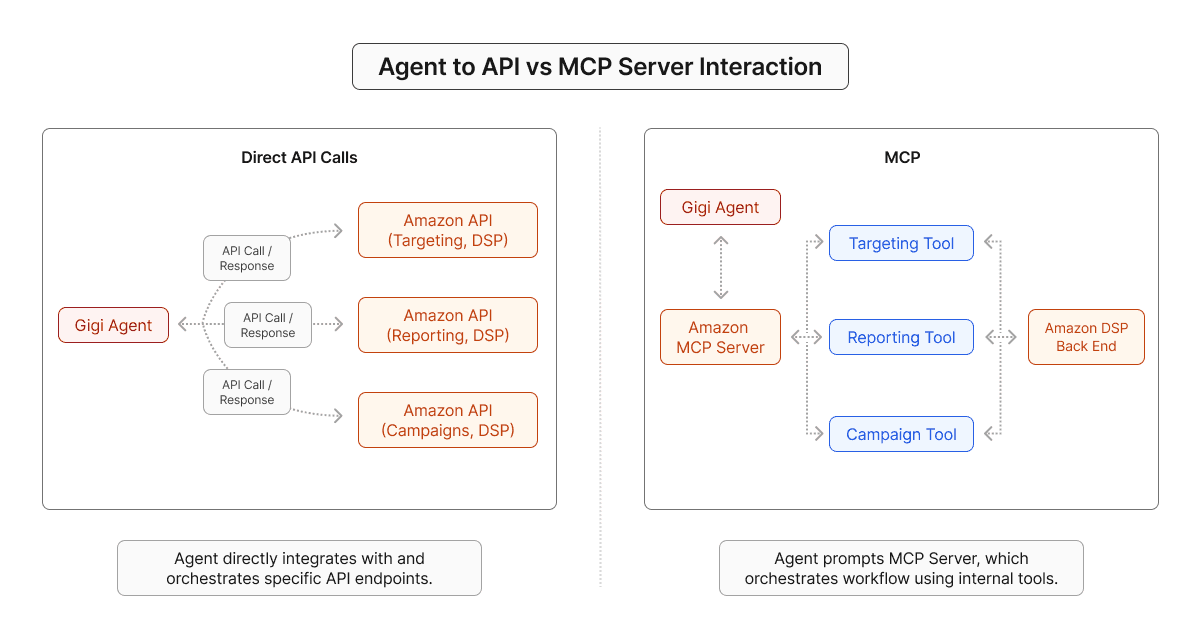
Sounds amazing, right? In theory, it is. In practice, the current MCP server state is very limiting.
The API Parity Problem
Having been an Amazon Ads partner for 8+ years, we’ve noticed that nothing frustrates customers more than hearing an Amazon Ads API doesn't support something they're accustomed to doing in the UI. Amazon has done excellent work mitigating these instances, but gaps exist. To combat this, we race to keep up with APIs. This can be maddening at times, but ultimately worthwhile. If an API supports a use case, we need to support it to keep customers happy.
Keeping up with APIs is costly. If successful, the MCP server could solve this: we wouldn't need to "keep up with the APIs", we could rely on the MCP server's pretrained workflows to understand the right API endpoints and present them to our AI agent. As Jason Cohen at Amazon Ads points out in this video, this protocol can "expedite the time it takes to do these integrations." In a future state, the protocol could enable leveraging tools "as the customer needs it." This last point is incredibly powerful: an AI agent might not even need direct tool integration if the MCP supports use cases enabled by tools the agent doesn't directly access.
The Reality Check
There's only one problem: The MCP server is limited in supported workflows, and reaching parity with Amazon Ads' UI and APIs will take considerable time. As it stands, it doesn't make sense for an AI agent like Gigi to leverage MCP because Amazon Ads has already created the most fertile playground possible for AI agents by building API-first for over a decade. I don't know how long it will take for the MCP server to reach API parity, but I'm fairly certain it will take several years.
Meanwhile, our customers want AI agents solving their problems right now. This feature parity issue only addresses one aspect of tool calling. It remains unclear whether Amazon's MCP will ever match the reliability, latency, and compute efficiency that purpose-built API orchestration can achieve. We're going to continue building tool calling sophistication with Amazon Ads' APIs. Yes, Amazon Ads' commitment to MCP is an exciting evolution. But for AI agents to rely on MCP as the primary integration mechanism with Amazon Ads, Amazon would need to adopt an MCP-first approach. Until then, APIs remain ideal.
Note: This blog first appeared in our Cherry Picked newsletter. You can subscribe here: https://cherry-picked-gigi.beehiiv.com/subscribe