March 18, 2026
5 min

Most of these companies start with the same value proposition: workflow automation. Legacy SaaS workflows get converted into declarative AI workflows. That creates real value, but it is also the least defensible layer and will likely commoditize quickly.
We think moats in agentic media buying will form in four layers, which can be thought of as a pyramid. The most defensible layer sits at the top; the most commoditized at the bottom. We'll work from the bottom up.
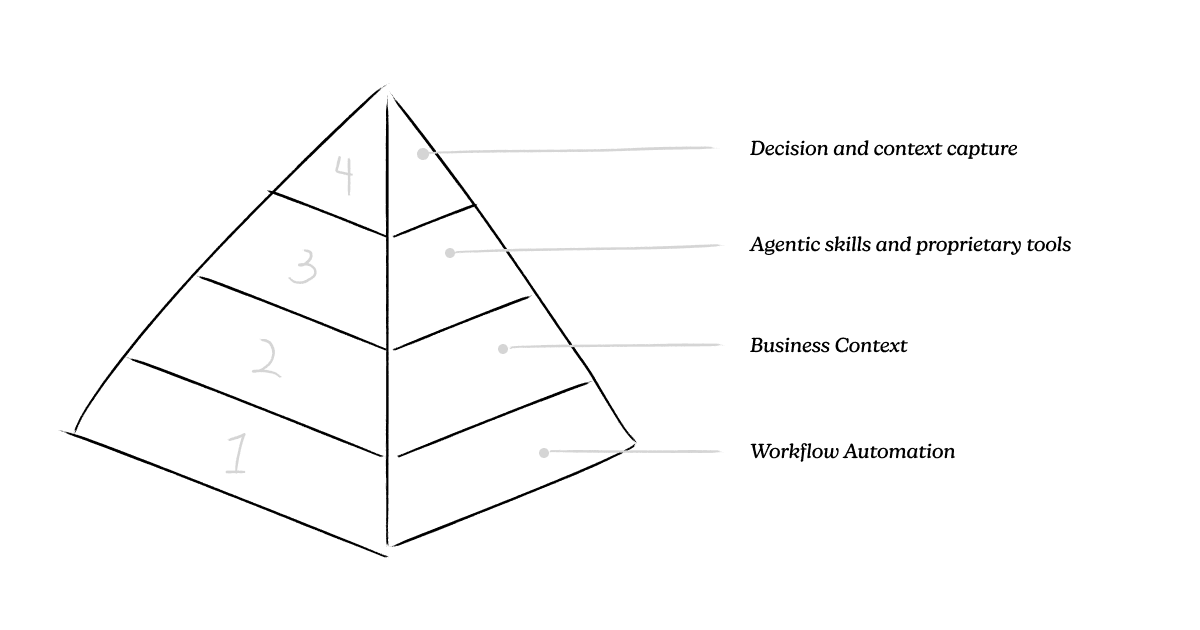
Each layer builds on the one below it. As you move up the pyramid, defensibility increases.
Layer 1: Workflow Automation
Workflow automation is the foundational layer of any media buying AI agent. It is also the least defensible. Jason Cohen at Amazon Ads calls this "feature AI":
Feature AI improves the user experience. It takes something that required expertise or manual effort and makes it faster or accessible. It's genuinely valuable. But it's buildable. A motivated competitor can replicate it in 12–18 months once the pattern is proven, because the components — the foundation models, the training data patterns, the interface frameworks — are increasingly generic.
We know this firsthand. It took us 18 months to cover more than 90% of the workflows a media manager handles inside the Amazon DSP, and to do so with the reliability, latency, and accuracy that enterprise customers actually require. When building on top of walled gardens, this means exposing every potential API endpoint as a callable tool. It is exhaustive work, but in theory any well-resourced team could eventually replicate it. The floor is high; the ceiling isn't.
Layer 2: Business Context
The next layer is where customer-level stickiness begins to form. Business context encompasses data, systems, and workflows, contributed from two directions: the company building the agent and the end customer themselves. This includes bespoke best practices, operating procedures, and the goals, objectives, and KPIs of the advertiser. The moat here is created at the customer level. When a customer invests time training and calibrating an AI agent with their own context, the switching costs begin to resemble those of onboarding a new team member with institutional knowledge that doesn't transfer easily. The longer the relationship, the deeper the context, and the greater the switching cost.
Layer 3: Agentic Skill Development and Proprietary Tools
This is where the company building the agent has to make a serious product bet. It is also where an important distinction emerges. The tools available at Layer 1 are the actions any well-resourced agent could take: API endpoints exposed as callable tools, available in theory to any competitor willing to do the engineering work. The tools built at Layer 3 are different in kind. These are proprietary systems developed by the company itself: models that score and rank opportunities, predict outcomes, assess risk, and determine whether the agent should act autonomously or escalate to a human. Rather than waiting for human direction, the agent built on this layer begins to analyze data, surface suggestions, and take actions on its own, grounded in infrastructure no competitor can simply replicate by connecting to the same APIs. The result is an agent that makes opinionated, data-rooted decisions with a degree of accuracy no human could consistently match. The proprietary tools become the edge.
Layer 4: Decision and Context Capture
At the top of the pyramid is the most durable moat of all: the accumulation of signal around decisions made and the context behind them. These decisions can come from humans or from agents. What's being captured is not just the "what" but the "why," and when layered on top of everything below it, this signal compounds into something genuinely proprietary.
A lot of people talk about 1P data as the differentiator in agentic AI media buying. They're not wrong, but they're thinking about it in the traditional sense: pixel-based audience pools, retargeting segments, PMP deal performance, bid win rates by supply source, CPM benchmarks by format and environment, SKU-level sales velocity, new-to-brand ratios. That's genuinely valuable. But it's not the real prize. The real proprietary data is decision and context signal: what the agent chose, under what circumstances, and what happened as a result. Over time, this is what makes the agent measurably smarter.
Once this layer is working, the agent doesn't just optimize within legacy workflows. It starts to question whether those workflows should exist at all. Ari Paparo described this as Stage 4 of AI adoption in this week's Markecture newsletter, where he sees a world in which agents:
Eliminate an entire workflow or component using AI. A theoretical example might be abandoning viewability as a metric entirely because AI works better without an intermediary measurement.
When Layers 3 and 4 are firing correctly, the agent has enough earned context and enough validated performance signal to render low-level human-operated levers obsolete, executing directly against higher-order business goals without the intermediary mechanics that legacy workflows were built around.
Where Gigi Sits and Where We're Going
A lot of people are questioning whether AI agents in media buying can build real moats. We began building Gigi in summer 2024, when only a small number of companies were working on this problem. Today, dozens of startups are launching each quarter to build agentic layers on top of major media platforms like Meta, Google, and DSPs.
After more than a year of focused product development, we've built something our customers genuinely love at Layers 1 and 2. Workflow automation for the Amazon DSP is largely solved. Business context, through structured onboarding, RAG-contributed best practices, and customer-specific goals, is working well. But we're clear-eyed that this isn't enough to build sustaining value on its own.
Looking ahead, we see our evolution along two tracks: moving up the pyramid for mature channels like the Amazon DSP, and rapidly building out Layers 1 and 2 for additional media channels. Both tracks feed each other.
A significant portion of our near-term product investment will be concentrated at Layers 3 and 4. At Layer 3, this means building the proprietary infrastructure that moves Gigi from task-executor to autonomous campaign manager: a permission hierarchy that routes decisions by risk and impact level, a scoring model that determines what the agent ecutes versus what it flags for human review, and lightweight causal models that allow Gigi to attribute outcomes to actions with enough confidence to act on them.
At Layer 4, the work is about building the institutional memory that makes Gigi permanently smarter with every campaign it touches. Concretely, this means logging every decision the agent makes, whether human-directed or autonomous, alongside the context that drove it: the campaign state, the goal, the reasoning, and the outcome. We're building a structured feedback loop that closes the attribution gap between action and result, so the system can continuously validate and sharpen its own judgment. Over time, this decision history becomes a proprietary corpus no competitor can acquire through engineering alone. It can only be earned through usage at scale.
In parallel, we're going wider, capturing more media channels at Layers 1 and 2. That breadth then feeds into Layers 3 and 4, providing the cross-channel signal Gigi needs to become genuinely powerful. Our moat gets wider and deeper at the same time.
Note: This was originally published as part of our Cherry Picked newsletter. Subscribe here ➡️ https://cherry-picked-gigi.beehiiv.com/subscribe